

Solution
Freezer temperature monitoring for stable low-temperature storage.
KRYOS gives teams a freezer monitoring system for freezer rooms, cabinets, and low-temperature units, without depending on the next manual check. When a freezer warms, recovers, or becomes unreliable, live readings, alarm ownership, response notes, and review-ready records stay tied to the frozen material, unit, and site under review.
- Monitor freezer rooms, cabinets, low-temperature units, backup freezers, and high-value frozen storage from one live view.
- Route freezer temperature alarms to the right team while thaw risk, door events, power issues, or equipment failures are still active.
- Keep freezer temperature records, incident notes, transfer context, and exports ready for stock, sample, customer, maintenance, or QA review.
Freezer coverage
One low-temperature record from sensor to review
Each monitored freezer keeps its temperature trend, alarm status, response context, and review record in one workflow.
-25 °C -20 °C -18 °C
Freezer room
Bulk low-temperature storage
-20.8 °C StableFreezer cabinet
Samples, stock, or frozen goods
-19.7 °C In rangeAlarm event
Threshold, duration, and response owner
-17.6 °C WatchReview record
Notes, transfer, reports, and exports
Linked ReadyFreezer readings, alarms, thaw-risk context, response notes, backup-transfer context, and exports remain tied to one low-temperature monitoring record.
Freezer temperature risk builds between an excursion and the follow-up record
A freezer excursion can be brief and still matter. Door openings, defrost cycles, power issues, slow recovery, and delayed response can warm stored material, then recover before a manual log explains whether thaw, refreeze, or product impact needs review.
Recovered freezers can hide thaw risk
A freezer can warm, partially thaw material, and return to an acceptable reading before the next inspection, leaving the team to reconstruct duration and exposure later.
Different freezer types need different context
A freezer room, cabinet, low-temperature freezer, ultra-low freezer, backup unit, or high-value storage point can carry different limits, urgency, probe placement, and owners.
Reviews need more than an alarm timestamp
Stock review, sample review, customer claims, QA decisions, and maintenance follow-up need readings, min/max exposure, recovery, acknowledgement, notes, transfers, and exports together.
How KRYOS supports freezer temperature monitoring
KRYOS connects calibrated freezer sensors, remote visibility, freezer temperature alarms, and documented follow-up so teams can protect low-temperature storage, spot recurring freezer performance issues, and preserve evidence after equipment failure or thaw-risk events.
Freezer, range, and threshold logic
Limits can reflect freezer rooms, cabinets, low-temperature and ultra-low storage where relevant, alarm delays, recovery expectations, and the team that owns escalation.
Probe, calibration, and placement context
Probe identity, certificates, battery state, recalibration planning, thermal representation, and placement notes can stay linked to each monitored freezer.
Material and equipment review
Teams can review freezer temperature history, alarm handling, min/max exposure, recovery patterns, transfers, notes, and exports without reconstructing the event timeline.
Monitor the right freezer point
Place sensors and external probes in freezer rooms, cabinets, backup units, or low-temperature storage points where the reading represents stored material, not only fast-changing air. Confirm representative probe placement, cable reach, an accessible powered device and the available network. Check the actual freezer type against the supplied configuration; an illustrated band is not its verified operating range. Use approved mapping where available as a placement input, not an included service, and assign the response owner.
Keep freezer status live
Cloud views show current readings, threshold state, trend history, recovery behaviour, recurring alarms, device health, and freezer-by-freezer visibility across sites.
Escalate freezer alarms
Temperature alerts help teams respond while readings are still out of range, so operations, QA, lab, food safety, facilities, or refrigeration support can act before review depends on a freezer temperature data logger file.
Preserve the freezer record
Reports and audit logs keep readings, acknowledgements, response notes, backup-transfer context, and exports available for stock, sample, customer, maintenance, or QA review.
Freezer proof from thaw risk to QA, customer, or maintenance review
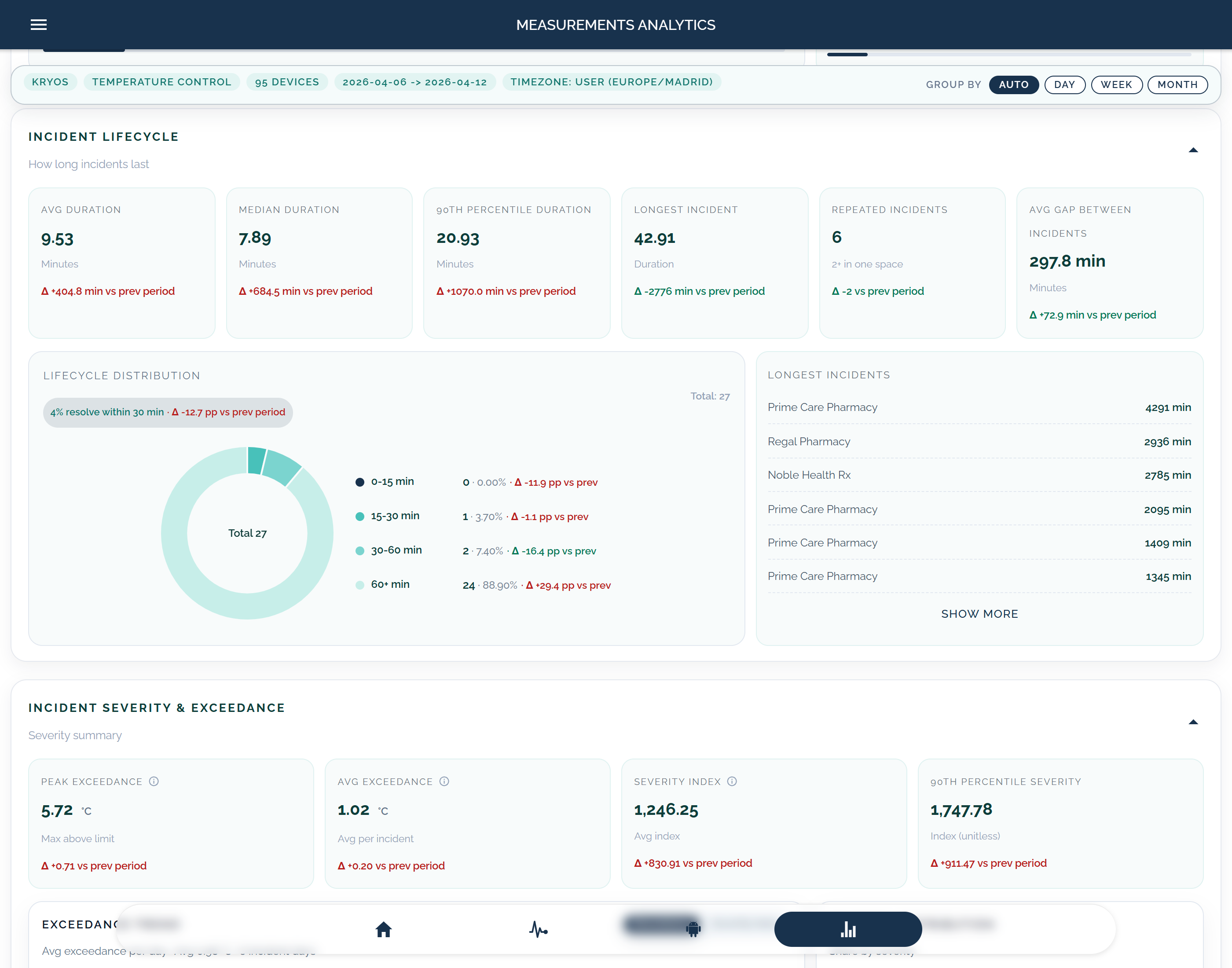
Use monitoring and incident screens to connect current freezer conditions, alarm response, recovery behaviour, and documented review across low-temperature storage operations.
- Live status across freezer rooms, cabinets, low-temperature units, backup freezers, and high-value frozen storage
- Incident context for threshold state, duration, min/max exposure, thaw-risk review, acknowledgement, response owner, and recovery
- Reports and audit logs for stock review, sample review, food quality, customer claims, maintenance review, and traceable freezer temperature review
Freezer record FZ-082
Product capabilities for freezer temperature monitoring
A temperature monitoring system for freezers needs connected sensing, active alarms, reporting, and rollout support across low-temperature storage points where excursions can affect frozen stock, samples, materials, or customer-owned goods.
Wireless temperature monitoring
Track freezer rooms, cabinets, backup units, low-temperature storage, and ultra-low points where relevant with remote visibility.
Alerts & alarms
Escalate freezer temperature alarms with thresholds, duration, acknowledgements, recovery, and response context.
Reports & audit logs
Keep freezer temperature records, exports, and incident timelines ready for material, stock, sample, customer, maintenance, or QA review.
Sensors & probes
Place calibrated probes where freezer conditions represent stored material, with context for thermal buffering, airflow, shelves, racks, or door exposure.
Map freezer temperature monitoring to your sites
Use a guided demo to review freezer rooms, cabinets, backup freezers, low-temperature or ultra-low points where relevant, probe placement, alarm paths, transfer response, reports, and installation expectations for your low-temperature storage workflow.
- Freezer, probe, and threshold mapping
- Thaw-risk and alarm response
- Material and QA review records
