

Solution
Laboratory temperature monitoring system for samples, reagents, and controlled lab assets.
KRYOS helps laboratory teams run a connected lab temperature monitoring system across lab refrigerators, lab freezers, sample storage, reagent storage, incubators where relevant, and controlled rooms without losing the context needed for response and review. Live readings, alert ownership, and traceable records stay tied to the material, unit, room, or workflow under review.
- Monitor lab fridges, lab freezers, incubators where relevant, controlled rooms, and humidity-sensitive areas where conditions affect stored materials.
- Route temperature alerts to the right laboratory, QA, research, calibration, engineering, or facilities team while the event is still active.
- Keep laboratory temperature records, notes, and exports ready for sample, reagent, QC, accreditation-style, customer, or internal quality review.
Laboratory coverage
One monitoring view across samples, reagents, and controlled lab assets
Each monitored freezer, refrigerator, incubator, room, or material storage point keeps its reading history, alert state, and review context in one laboratory monitoring workflow.
Sample freezer
Low-temperature samples or retained material
-20.6 °C StableLab refrigerator
Reagents, controls, standards, and kits
4.3 °C In rangeIncubator or room
Controlled environmental condition
36.8 °C WatchReview file
Events, notes, impact review, and exports
Linked ReadyKRYOS preserves the environmental record; the laboratory keeps the scientific, QA, customer, or material-use decision.
Laboratory temperature gaps appear between stored material, alerts, and result confidence
The weak point is often not the reading itself. It is the gap between a deviation in sample, reagent, control, standard, kit, or incubator storage, the team that should respond, and the documented record later needed for QA, accreditation-style, research, calibration, or customer review.
Many small assets hold critical material
Bench fridges, reagent refrigerators, sample freezers, ultra-low freezers where relevant, incubators, cold rooms, prep rooms, and shared equipment rooms can each carry different material and review implications.
Manual checks and logger downloads miss the full story
A lab freezer, refrigerator, incubator, or controlled room can drift overnight, recover before opening, or show only a current value. A lab temperature logger may show part of the trend later, but response notes and ownership can still remain undocumented.
Excursions need material-specific review
After an excursion, teams may need evidence for quarantine, retesting, rejection, replacement, supplier review, study impact, method impact, result confidence, or customer communication.
How KRYOS supports a lab temperature monitoring system
KRYOS connects sensing, remote laboratory temperature monitoring, alert handling, and documented follow-up so laboratory teams can protect samples, reagents, controls, standards, kits, retained material, and controlled storage in one workflow.
Material-aware threshold logic
Thresholds can reflect individual freezers, refrigerators, incubators where relevant, controlled rooms, humidity-sensitive spaces, and the team that owns the escalation path.
Sensor and calibration context
Sensor identity, probe placement, battery state, calibration context, and ISO/IEC 17025 certificate references where applicable remain linked to the monitored laboratory storage point.
Review-ready evidence
Teams can review temperature or humidity history where relevant, alert handling, notes, and exports without rebuilding the event timeline by hand.
Cover the material and storage point
Place sensors and external probes in lab refrigerators, low-temperature freezers, incubators where suitable, controlled rooms, and humidity-sensitive areas where the monitored condition represents the stored material or process environment. Confirm representative probe placement, cable reach, an accessible powered device and the available network. Confirm the actual sample or reagent unit and environmental conditions. Incubators and ultra-low storage require application-fit checks, not assumed assembly validation. Keep the individual temperature certificate distinct from manufacturer humidity calibration; scientific and QA decisions stay with the laboratory.
Keep many lab assets visible
Cloud views show live readings, threshold status, device health, and unit-by-unit visibility across laboratories, prep areas, support rooms, shared equipment, satellite rooms, and multi-site lab groups.
Escalate by ownership
Temperature alerts help route an active event to the lab manager, QA owner, research lead, calibration owner, engineering team, facilities contact, or operations team that can respond.
Preserve the review record
Reports and audit logs keep readings, acknowledgements, response notes, duration, min/max exposure, ISO/IEC 17025 calibration context where applicable, and exports available for later material, result, QA, accreditation-style, or customer review.
Laboratory proof from live monitoring to review
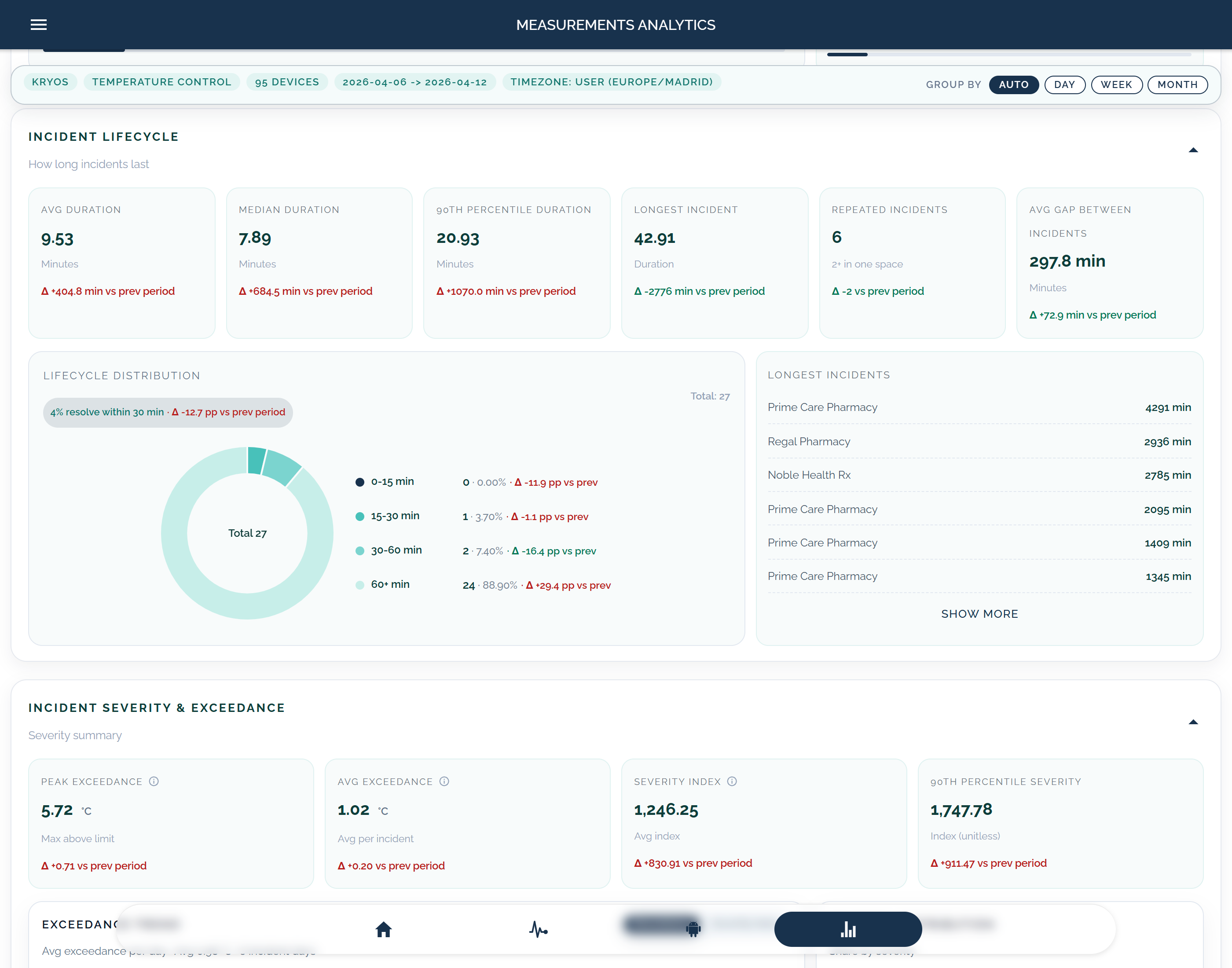
Use monitoring and incident screens to connect current storage conditions, alert response, material context, and documented review across laboratory operations.
- Live status across lab refrigerators, lab freezers, incubators where relevant, controlled rooms, and humidity-sensitive spaces where relevant
- Incident context when a sample, reagent, control, standard, kit, retained material, or room threshold is crossed
- Reports and audit logs for QA, ISO/IEC 17025-style accreditation or calibration review, research, customer, and internal laboratory review
Evidence file LB-204
Product capabilities for laboratory temperature monitoring
Laboratory temperature monitoring needs connected sensing, active alerts, reporting, and rollout support across controlled storage, sensitive materials, shared equipment, and quality-critical review records.
Wireless temperature monitoring
Track lab refrigerators, lab freezers, incubators where suitable, controlled rooms, and material storage points with remote visibility.
Alerts & alarms
Escalate out-of-range readings with threshold, acknowledgement, and response context.
Reports & audit logs
Keep laboratory temperature records, exports, incident timelines, and response notes ready for QA, inspection, customer, or internal review.
Sensors & probes
Place sensors and probes where the monitored unit, freezer zone, incubator environment, or controlled room condition represents the material under review.
Map laboratory temperature monitoring to your sites
Use a guided demo to review laboratory freezers, refrigerators, incubators where relevant, controlled rooms, humidity-sensitive areas where relevant, alert paths, reports, and installation expectations for your laboratory temperature monitoring workflow.
- Sample, reagent, and unit mapping
- Scientific, QA, and facilities alert paths
- Review-ready records and audit logs
